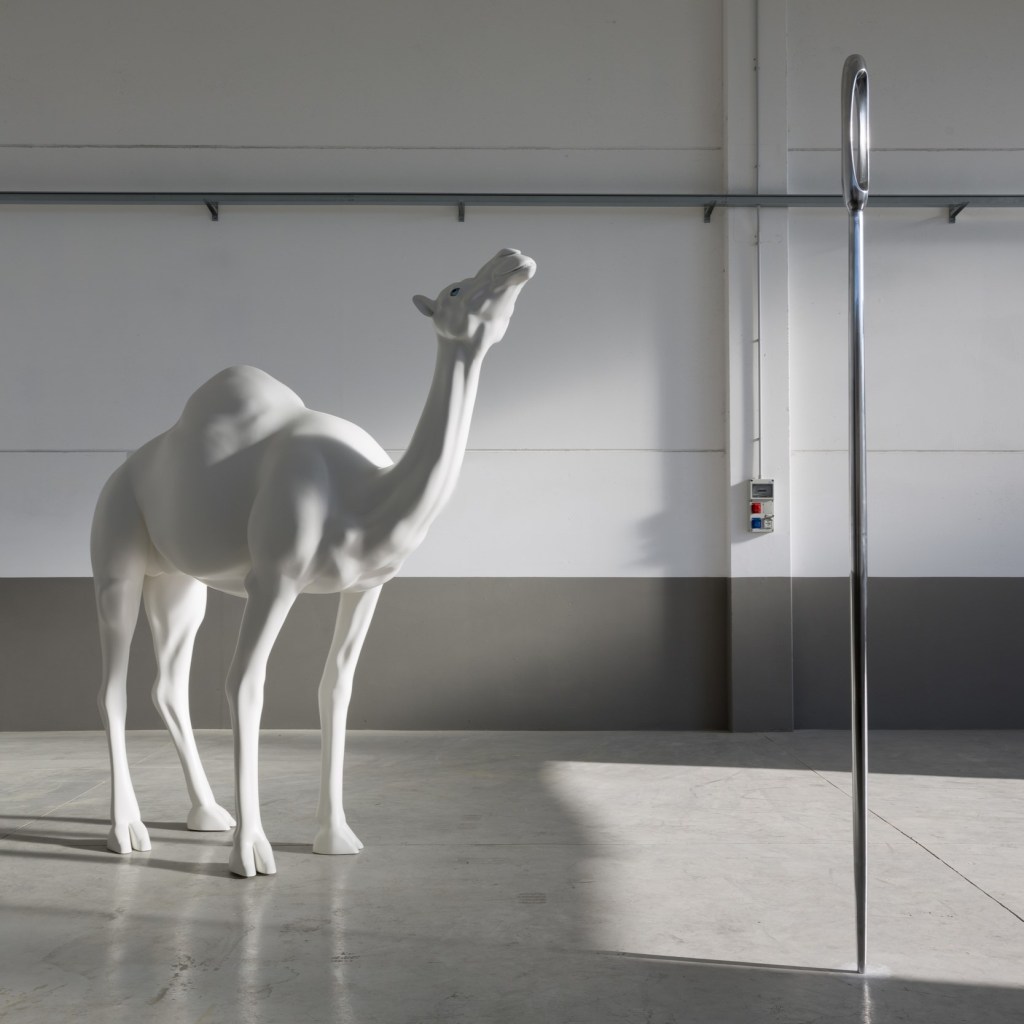
Baldessari, John – Camel Contemplating Needle, 2013
It is easier for a camel to pass through the eye of a needle than for one who is rich to enter the kingdom of God (Mark 10:25).
It is clear that richness and poverty are a matter of quantity. Richness (possession of things) takes up many space (if you don’t agree, please ask Marie Kondo). Poverty, on the other hand, consists in emptiness, precisely in the absence of things. The poor is the one who has the least things. The rich are full, and the poor are empty. But poverty can be spiritually positive, in a very deep meaning: to be poor is to gain interior space (humility) so that God can enter into the soul (Cf. Luke 1:26-38). And, at the same time, poverty is about to lose weight (to lose superfluous things, self-emptying) in order to be able to enter into God, to be able to pass “through the eye of a needle”, to be able to pass through the narrow gate (Luke 13:24), like Alice in Wonderland. Why? – You might think – If God is great, if God is Big! What does God have to do with the eye of a needle? And the answer is: no, God in fact is very little, and smaller than the eye of a needle, as explained Pseudo Dionysius the Aeropagite in the 6th century: But little i.e. fine, is affirmed respecting Him,— that which leaves behind every mass and distance, and penetrates through all, without hindrance. Yet the little is Elemental Cause of all, for nowhere will you find the idea of the little unparticipated (…) This littleness is without quality and without quantity, without restraint, without limit, without bound, comprehending all things, but itself incomprehensible[1].
Find the divine littleness: pass through the eye of a needle and you will find God. He is behind the eye of the needle, because God is so great that he can become small[2], that’s the Christmas lesson. For this reason, Jesus said, unless you turn and become like children (little), you will not enter the kingdom of heaven (Matthew 18, 3). Blessed are the poor in spirit, for theirs is the kingdom of heaven (Matthew 5, 3).
[1] Pseudo Dionysius the Aeropagite, On Divine Names, Chapter IX, Section III, quoted in John Parker, The Works of Dionysius the Aeropagite, Part I, James Parker & Co, London 1897, p. 103
[2] Benedict XVI, Homily in the Midnight Mass, Vatican Basilica, Saturday, 24 December 2005
Descubre más desde De Arte Sacra
Suscríbete y recibe las últimas entradas en tu correo electrónico.
 De Arte Sacra