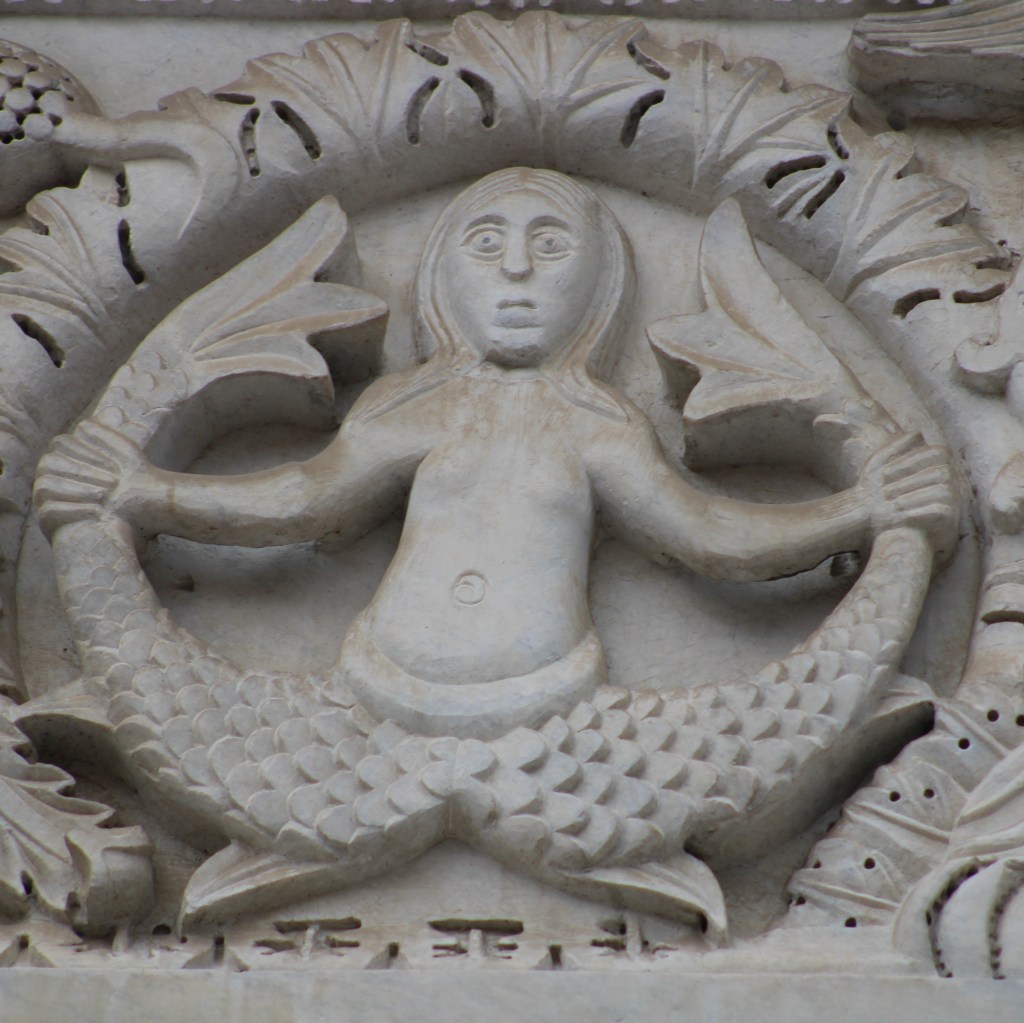
Guidetto da Como – Duomo di Lucca – Façade (detail), 12th–13th centuries
The verses of chapter 13 of Isaiah are part of the Lord’s oracle against Babylon, the city symbol of vainglory and sin. There, in a symbolic manner, beasts and jackals are described as inhabiting luxurious palaces:
But wildcats shall rest there and owls shall fill the houses; There ostriches shall dwell, and satyrs shall dance. Desert beasts shall howl in her castles, and jackals in her luxurious palaces. Her time is near at hand and her days shall not be prolonged (Isaiah 13:21–22).
It is a critique of a superficial and worldly way of life, far from God. The Latin term for jackals is thoes, which indeed could be translated as jackals or wild beasts. Saint Jerome, in his translation of the Vulgate, chooses the term sirens: et sirenes in delubris voluptatis.
This is a more mythological and allegorical interpretation of the term jackals/wild beasts, which the saint takes from the Greek translation of the Septuagint. He explains this in his commentary on the book of Isaiah[1].
Saint Jerome uses the term inspired by the Greek culture, in which sirens were a symbol of seduction (one only needs to recall the stories of Ulysses and Orpheus).
For Jerome, the sirens symbolize seduction, as they lead to sin, to the attitude of Babylon, to a life apart from God and given over without restraint to worldly pleasures. The sirens have a woman’s form above down to the navel, but their lower part down to the feet has the shape of a fish[2]. According to certain medieval traditions, the female part symbolizes seduction, and the fish part symbolizes sin and its coldness.
Sirens are often depicted with a double fish tail, to make the erotic component of their seduction more explicit. Such is the representation on the façade of the Cathedral of Lucca (Italy, construction began in the 11th century): a siren with a double tail. That image is very powerful, and it appears in other European churches as well. It is the stone representation of seduction.
The same applies to Starbucks, whose founders wanted to represent just that: You can’t resist the coffee song, you feel persuaded to enter into each of the Starbucks locations. It is a seduction so powerful that it is irresistible.

The siren of Lucca is placed on that façade as a warning of a danger to be avoided. The siren of Starbucks is on the façades of its shops as a warning of a danger that, deep down, you know you cannot resist—and don’t want to either. The siren of Lucca seems more moralizing, but its intention is to set you free. The siren of Starbucks seems liberating, but its intention is to bind you in dependence. The first one is liberating, it is hopeful: It marks the entrance to the purest and the most spiritual, the kingdom of freedom. The second one is fatalistic: “you won’t be able to resist the addiction”.
[1] José Anoz (ed), San Jerónimo. Obras Completas. Comentarios a Isaías, BAC, Madrid 2007, p. 303
[2] Richard Barber, Bestiary: Being an English Version of the Bodleian Library, Oxford MS Bodley 764, in the commentary on manuscript Bodley 764, folio 74v
Descubre más desde De Arte Sacra
Suscríbete y recibe las últimas entradas en tu correo electrónico.
 De Arte Sacra