«Do not be afraid». Here is the essential element of vocation: because human beings are afraid (John Paul II[1])
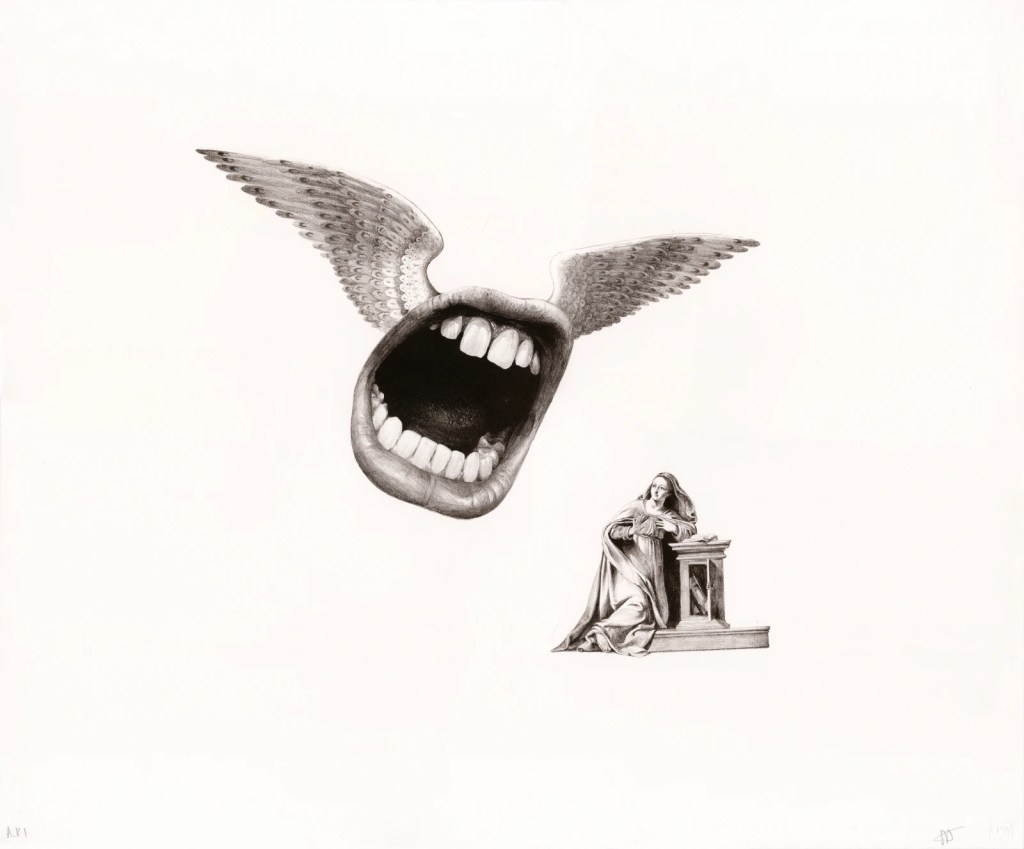
Jessica Harrison – The Annunciation, Lithograph, 2007
In general, when human beings encounter God, they are afraid. Humanity fears the divine because it realizes that the divine surpasses its own strength and even its nature. Human beings feel alone before the void of the impossible, and this fills them with fear.
One might think that encountering the divine brings peace to the heart. This may indeed happen after an imposing ascetic struggle and rigorous training. But in the first instance, contact with God produces fear, for human beings become aware of how radically different God is from them. It is overwhelming that the God who is “Wholly Other” should cross the “the spaces of that infinite «distance» which separates the Creator from the creature”[2]. The closeness of omnipotence leaves human beings frozen with fear.
Anything we say or understand about God lies beyond our reason, and we can only know God in the darkness of our reason[3]. A God who “made darkness his covering, his canopy around him— the dark rain clouds of the sky” (Psalm 18: 11) is a God who is frightening when He comes close. For this very reason, “do not be afraid” functions like a refrain throughout the Bible whenever human beings encounter God. God needs to say “do not be afraid” because He knows that human beings are afraid, hit by the contrast between the finitude of humanity and the infinity of God.
“Do not be afraid, Abram. I am your shield, your very great reward.” (Genesis 15:1)
“Do not be afraid. Stand firm and you will see the deliverance the Lord will bring you today.” (Exodus 14:13)
“Be strong and courageous. Do not be afraid or terrified… for the Lord your God goes with you.” (Deuteronomy 31:6)
“Fear not, for I am with you; be not dismayed, for I am your God.” (Isaiah 41:10)
“Do not be afraid, you who are highly esteemed… peace! Be strong now; be strong.” (Daniel 10:19)
The song of “Do not be afraid” has its final verse in the Annunciation to Mary: “Mary was greatly troubled at his words and wondered what kind of greeting this might be. But the angel said to her, “Do not be afraid, Mary; you have found favor with God. You will conceive and give birth to a son, and you are to call him Jesus.” (Luke 1:29-31).
The Annunciation is the great lesson in learning to overcome fear, in learning to trust a God who leads us into unknown terrain (“I will lead the blind by ways they have not known, along unfamiliar paths I will guide them” – Isaiah 42:16), but at the same time into places where new life is discovered.
This is how John Paul II understood the Annunciation:
“All human beings are born to your “yes.” This must be understood: such a “yes,” in imitation of Mary, creates joy, a new life, a breath, a blessing. A “yes” like Mary’s—what a blessing! What fullness of goodness in the world! Even with all that is suffering, all that is sin in this world. A “yes” of Mary: how much blessing! How much joy! How much happiness! How much salvation! How much hope!
And so, analogically, in due proportion, your “yes,” your faithfulness—whether husband, wife, young person, doctor, professor—your distinct “yes” creates joy, the world is reborn; and human life—in its various dimensions, in the social dimension, in the different environments, family, parish, professional—becomes more human, thanks to such a “yes.”
Thus have I contemplated the mystery of the Annunciation and, at the same time, the mystery of the Christian vocation.”[4]
[1] Address of John Paul II to the Pontifical Roman Major Seminary, Solemnity of the Annunciation of the Lord, Thursday, March 25, 1982
[2] John Paul II, Redemptoris Mater, n. 51
[3] Cfr. Dionysius the Areopagite, Divine Names and Mystic Theology, edited by John Parker, The Works of Dionysius the Areopagite, James Parker and Co, London 1897
[4] Address of John Paul II to the Pontifical Roman Major Seminary, Solemnity of the Annunciation of the Lord, Thursday, March 25, 1982
Descubre más desde De Arte Sacra
Suscríbete y recibe las últimas entradas en tu correo electrónico.
 De Arte Sacra