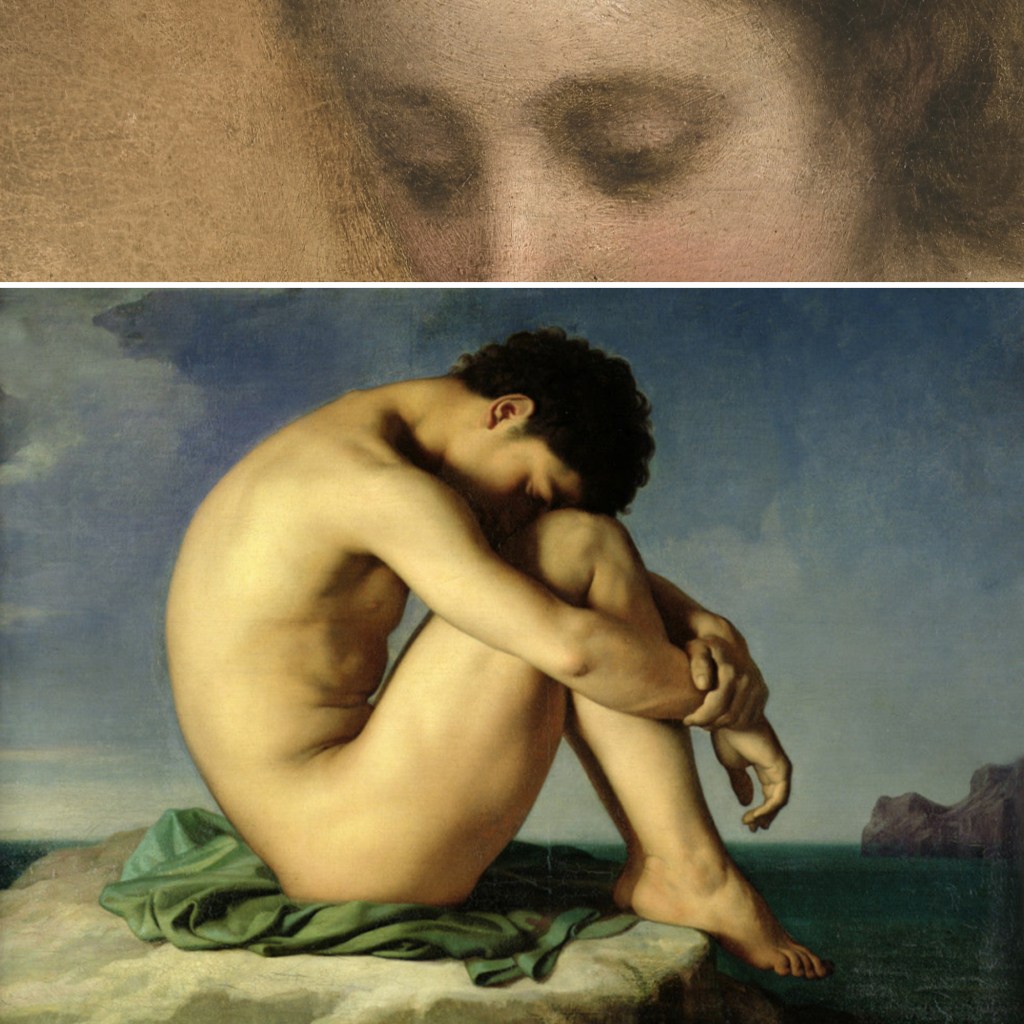
Composition: Flandrin, Hippolyte – Jeune homme nu assis au bord de la mer, 1836, Louvre & Murillo, Bartolomé Esteban – San Felix de Cantalicio con la Virgen y el Niño, 1668/1669, Museo de Bellas Artes de Sevilla (detail)
Since the beginning of time, the human being has experienced an anguishing guilt when he has deliberately betrayed his conscience. This anguish is expressed in the turning away of his gaze from God (the Creator of human conscience). Before the betrayal of conscience, man is at peace with God. After the betrayal (after the sin), man turns his gaze away from God. This is what happened in the first sin: «When they heard the sound of the Lord God walking in the garden at the time of the evening breeze, the man and his wife hid themselves from the presence of the Lord God among the trees of the garden.» (Genesis 3:8)
This turning away was also experienced in first person and dramatically described by Cain, the author of the second sin: «Cain said to the Lord, ‘My punishment is too great to bear. Since you have now banished me from the ground, I must avoid your presence and become a restless wanderer on the earth. Anyone may kill me at sight.'» (Genesis 4:13-14)
Cain, as God will make him realize, is mistaken, but he will have to start an entire process of conversion before he can lift his face toward God again (conversion, in Latin, means «to turn one’s face,» «to turn one’s gaze back»). Cain’s victimizing and self-centered attitude is the great temptation of the sinner, of each sinner: to remain focused on himself—withdrawn, closed off, hopeless, trapped, abandoned to himself: sibi relicto, as Saint Thomas Aquinas says.
The people of Israel, throughout their history, will fight a constant battle to open themselves and once again contemplate the Face of God. They will fight between two opposing forces: the inability to look God in the eyes and the unstoppable desire to do so. This is the paradoxical tension in which Cain finds himself after his sin.
The same tension was experienced by the sinful woman described in the Gospel. The Lord came to her rescue to break this vicious cycle, and the first thing the woman did was encounter the Face of God: «Then Jesus said, ‘Neither do I condemn you. Go, and from now on do not sin any more.'» (John 8:11)
The rescue by God is what Cain’s exiled heart longs for the most.
Those big eyes,
waiting eyes.
Those big eyes,
loving eyes,
pleading eyes,
pained, smiling.
And myself looking
so cowardly,
so poor,
so small,
so lost.
Afraid of life,
afraid of those eyes.
And the eyes,
so understanding,
sunk in patience,
softly crying:
Do not run!
Foolish child,
do you think,
if you flee,
that other eyes
could see you
as I see?
Descubre más desde De Arte Sacra
Suscríbete y recibe las últimas entradas en tu correo electrónico.
 De Arte Sacra
Thank you for your reflection, David. As the transparent echo of «Spiegel im Spiegel» (Arvo Pärt) resounds, I feel that those eyes not only look at me, but hold me. It’s not a gaze that demands, but a gaze that waits; not a gaze that judges, but one that calls. And in that gaze, and in that silence, I recognise myself, I discover myself, and I know myself to be truly loved.
Me gustaMe gusta