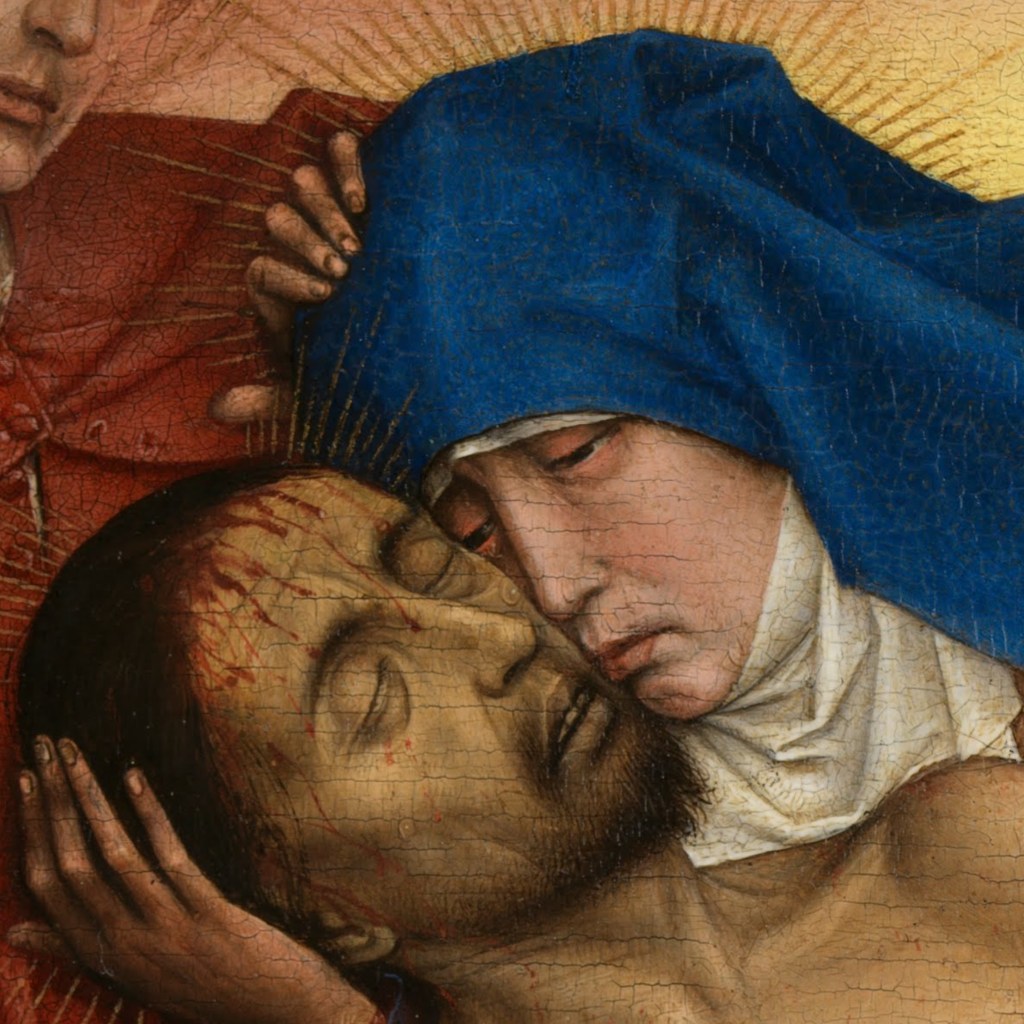
Rogier van der Weyden – Pietà, 1441, Royal Museums of Fine Arts of Belgium
In the Gospel the tears take on a notable protagonism… and Jesus is very familiar with the tears of the Gospel characters.
When they arrived at the house of the synagogue official, he caught sight of a commotion, people weeping and wailing loudly. So he went in and said to them, «Why this commotion and weeping? The child is not dead but asleep” (Mark 5:38-39[1]).
Now there was a sinful woman in the city who learned that he was at table in the house of the Pharisee. Bringing an alabaster flask of ointment, she stood behind him at his feet weeping and began to bathe his feet with her tears. Then she wiped them with her hair, kissed them, and anointed them with the ointment (Luke 7:37-38)
Soon afterward he journeyed to a city called Nain, and his disciples and a large crowd accompanied him. As he drew near to the gate of the city, a man who had died was being carried out, the only son of his mother, and she was a widow. A large crowd from the city was with her. When the Lord saw her, he was moved with pity for her and said to her, «Do not weep.» He stepped forward and touched the coffin; at this the bearers halted, and he said, «Young man, I tell you, arise!» The dead man sat up and began to speak, and Jesus gave him to his mother (Luke 7:11-15)
And the Lord turned and looked at Peter; and Peter remembered the word of the Lord, how he had said to him, «Before the cock crows today, you will deny me three times.” He went out and began to weep bitterly. (Luke 22:61-62)
Unexpectedly, Jesus weeps twice in the Gospel. These are the shortest verses in the Bible, and, according to Makoto Fujimura, the most synthetic ones.
As he drew near, he saw the city and wept over it (Luke 19:41)
And Jesus wept (John 11:35)
“Jesus wept” – and continues to weep today. Tears of God are powerful. They may evaporate, or soak the ground, but they never disappear. We breathe today the tears of Jesus[2].
Archaeologists have discovered that in biblical times, there were objects that now we call “tear jars”. Tears were so coveted that people kept them in jars. Jesus’s tears were not collected. They dropped one by one onto the hardened ground of Bethany. They evaporated into the air, and they are still with us today. We can collect them by faith today. Our institutions, and our lives, should be made up of these jars of tears. Our theology should carry the gratuitous, extravagant weight of those tears. This is the miracle of the intuitive: to invoke mystery that no analysis can tap into.
These tears (…) embedded themselves into the fabric of the atmosphere. Our tears need to comingle with Jesus’s tears[3].
This mixture of tears, in which it is difficult to distinguish those of the creature from those of the Creator, is perfectly expressed in the painting of Van der Weyden, the great portraitist of tears. Two different people with a single love, breathing the same evaporated tears, looking, as Makoto Fujimura would say, towards a new creation.
[1] Cfr. Matthew 9:18-26 and Luke 8:51-52
[2] Makoto Fujimura, Art And Faith. A Theology of Making, Yale University Press, 2020, p. 119
[3] Makoto Fujimura, Art And Faith. A Theology of Making, Yale University Press, 2020, p. 111-112
Descubre más desde De Arte Sacra
Suscríbete y recibe las últimas entradas en tu correo electrónico.
 De Arte Sacra